
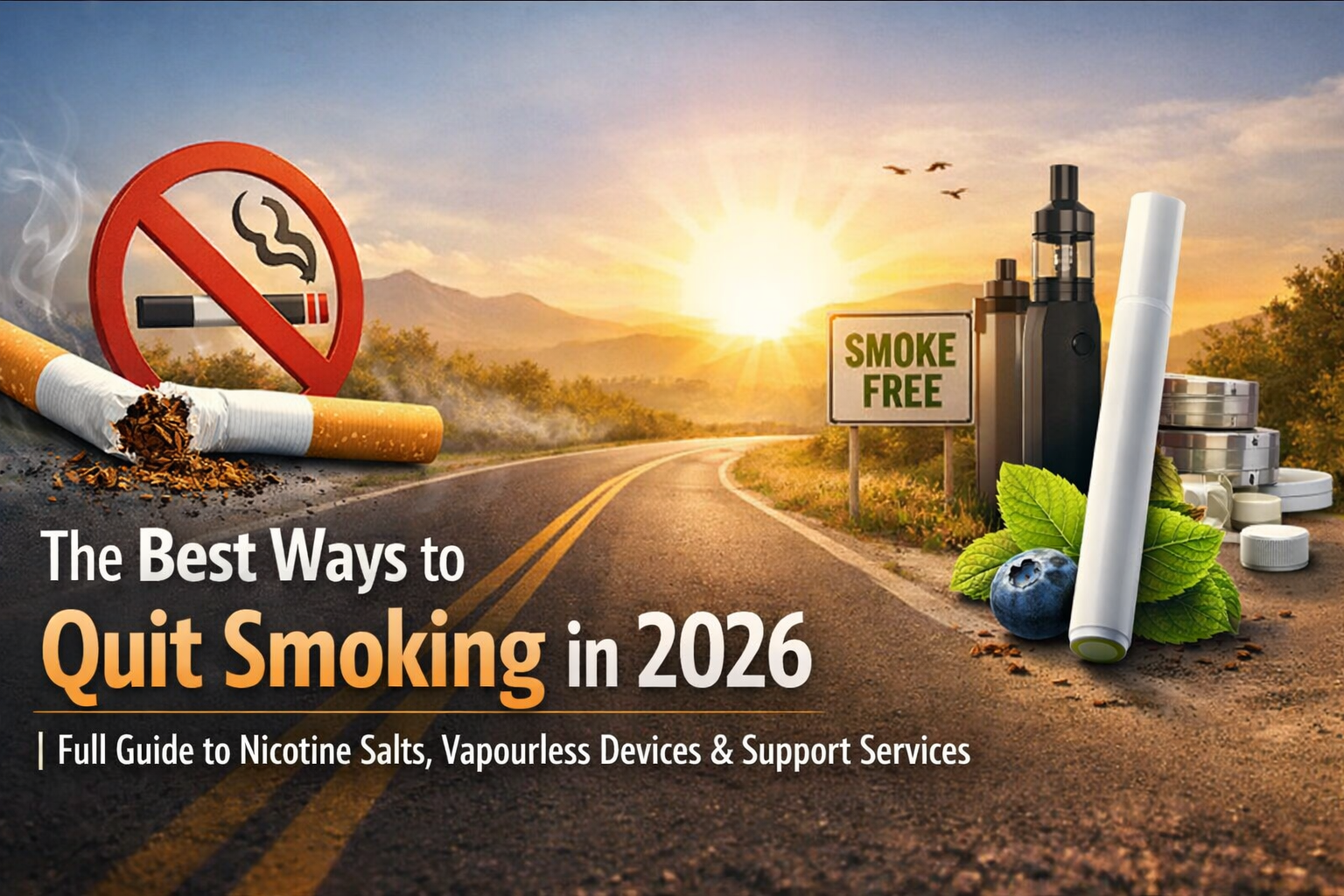
If you’re looking for the best ways to quit smoking, you’re not alone. Whether you’re thinking about switching to nicotine salts, trying vapourless flavour‑infused breathing devices, using nicotine pouches, or accessing local stop‑smoking services like Smokefree Hampshire, there are more options than ever to help you quit for good.
This guide explains the main quit‑smoking tools, how they work together, how the national Swap to Stop scheme fits in, and how White Vape Co can support you at every stage of your journey.
Table of Contents
- Why quitting smoking is harder than it looks
- The two sides of addiction: nicotine vs habit
- A four‑phase method: structuring the best ways to quit smoking
- Nicotine salts: one of the best ways to quit smoking quickly
- Choosing the right pod kit for nicotine salts
- Phase 2: reducing nicotine safely
- Vapourless, flavour‑infused breathing devices
- Nicotine pouches: long‑lasting nicotine without inhaling
- Patches, gum, lozenges, sprays & inhalators
- Smokefree Hampshire & the Swap to Stop scheme
- Phase 4: staying smoke‑free and nicotine‑free
- How White Vape Co supports your quit journey
- FAQs: the best ways to quit smoking
Why quitting smoking is harder than it looks
Most people think quitting is just about willpower, but the reality is more complex. Smoking is both a chemical addiction to nicotine and a behavioural habit built into your daily life. The best ways to quit smoking recognise both sides and treat them in stages, not all at once.
The two sides of addiction: nicotine vs habit
Nicotine dependence
Your body is used to regular nicotine. When levels drop, you can experience withdrawal: irritability, anxiety, poor concentration, headaches and strong cravings.
Habit dependence
Your brain is used to the ritual: holding something, inhaling, taking a break, the throat sensation, the after‑meal cigarette, the “stress cigarette”, the social cigarette. Even when nicotine is reduced, the habit can still feel powerful.
The best ways to quit smoking deal with both: first stabilising nicotine, then breaking the habit.
A four‑phase method: structuring the best ways to quit smoking
A realistic, high‑success approach usually follows four phases:
- Phase 1: Replace cigarettes with safer nicotine (e‑liquids, nicotine salts, pouches, etc.).
- Phase 2: Gradually reduce nicotine strength and frequency.
- Phase 3: Break the habit using tools like vapourless, flavour‑infused breathing devices.
- Phase 4: Maintain a smoke‑free, nicotine‑free lifestyle with ongoing support if needed.
This phased structure is one of the best ways to quit smoking because it avoids overwhelming your body and mind at the same time.
Nicotine salts: one of the best ways to quit smoking quickly
For many smokers, especially those who smoke daily or heavily, nicotine salts are one of the best ways to quit smoking because they deliver nicotine quickly and smoothly, in a way that feels close to smoking.
You can explore a full range of nicotine salt e‑liquids here:
Nicotine Salts at White Vape Co
Why nicotine salts work so well
Nicotine salts are absorbed faster than traditional freebase nicotine, which means:
- Cravings are satisfied quickly.
- You don’t need to vape constantly.
- Higher strengths feel smoother on the throat.
- The experience feels familiar to a cigarette.
For many people, this makes nicotine salts one of the most effective starting points when looking for the best ways to quit smoking.
Choosing the right pod kit for nicotine salts
To get the most from nicotine salts, you’ll need a simple, reliable pod kit. These devices are low‑power, easy to use, and designed to work perfectly with salt‑based e‑liquids.
Browse suitable devices here:
Starting with the right device and nicotine strength is one of the best ways to quit smoking without feeling like you’re “missing something”.
Phase 2: reducing nicotine safely
Once you’ve switched from cigarettes to vaping or other nicotine products and feel stable, you can begin to reduce your nicotine strength. A typical step‑down path might look like:
- High strength (e.g. 20 mg) → medium (10 mg)
- Medium (10 mg) → low (5 mg)
- Low (5 mg) → 0 mg
Reducing gradually is one of the best ways to quit smoking without triggering strong withdrawal. You stay in control, and your body adjusts over time.
Vapourless, Flavour‑Infused Breathing Devices
Even after nicotine is reduced or removed, many people still miss the feeling of smoking: the inhale, the hand‑to‑mouth motion, the “pause” in their day, the throat sensation, or simply having something to reach for when stressed. This is why vapourless, flavour‑infused breathing devices have become one of the most powerful and overlooked tools in the list of the best ways to quit smoking.
These devices are designed to support the behavioural side of addiction — the part that nicotine replacement alone cannot fix. They recreate the sensory experience of smoking without delivering nicotine, vapour, or smoke. This makes them ideal for people who have already reduced nicotine or reached 0mg but still feel attached to the ritual.
What exactly are vapourless, flavour‑infused breathing devices?
These devices use a combination of airflow resistance, flavour infusion, and controlled breathing to mimic the sensation of inhaling from a cigarette or vape. They contain:
- No nicotine
- No vapour
- No smoke
- No battery or heating element
Instead, they rely on flavoured airflow and to create a familiar sensation. When you inhale through the device, air passes through a flavour‑infused chamber, delivering a clean, satisfying taste and a gentle resistance that feels similar to drawing on a cigarette.
The behavioural science behind why they work
Smoking is not just a chemical addiction — it’s a deeply conditioned behavioural loop. Over years of smoking, your brain wires itself to associate certain actions with relief, reward, or comfort. This is known as the habit loop, made up of:
- Trigger (stress, boredom, finishing a meal, driving, socialising)
- Action (lighting a cigarette, inhaling, hand‑to‑mouth motion)
- Reward (relief, satisfaction, grounding, sensory pleasure)
Even when nicotine is removed, the trigger → action → reward loop remains. This is why many people relapse weeks or months after quitting — not because they need nicotine, but because they miss the ritual.
Vapourless breathing devices work because they interrupt the habit loop without removing the reward. They give you the action and the sensory satisfaction, but without nicotine. Over time, this retrains your brain to break the association between triggers and smoking.
The neuroscience: how the brain responds to ritual replacement
When you inhale through a vapourless device, several things happen in the brain:
- Dopamine modulation: Flavour and sensory stimulation trigger mild dopamine release, reducing cravings.
- Reduced amygdala activation: Controlled breathing calms the brain’s stress centre, lowering anxiety.
- Prefrontal cortex engagement: The act of choosing a healthier ritual strengthens self‑control pathways.
- Reward pathway substitution: The brain begins to associate the new ritual with relief instead of cigarettes.
This is why vapourless devices are so effective for people who say, “I don’t want nicotine — I just want something to do.”
Breathing physiology: why inhalation itself reduces cravings
One of the most underrated aspects of smoking is the it creates. Smokers often take slow, deep inhales followed by long exhales — a pattern identical to many relaxation techniques.
Vapourless breathing devices encourage the same pattern, which:
- Activates the parasympathetic nervous system
- Reduces cortisol (stress hormone)
- Slows heart rate
- Creates a sense of calm
- Reduces the intensity of cravings
This is why many people feel instantly calmer when using these devices — even without nicotine.
Why vapourless devices prevent relapse
Most relapses happen during:
- Stressful moments
- Social situations
- Alcohol consumption
- Driving
- After meals
- Periods of boredom
These are moments when the habit is triggered, not the nicotine need. Vapourless devices give you something to reach for during these moments, preventing the “just one cigarette” spiral that leads to full relapse.
How vapourless devices compare to vaping and smoking
| Feature | Smoking | Vaping | Vapourless Device |
|---|---|---|---|
| Nicotine | Yes | Optional | No |
| Hand‑to‑mouth action | Yes | Yes | Yes |
| Inhale sensation | Yes | Yes | Yes (airflow resistance) |
| Flavour | Minimal | Strong | Moderate |
| Harm | High | Low | None |
When to introduce a vapourless breathing device
White Vape Co typically recommends introducing one when:
- You’ve reduced nicotine to 5mg or 0mg
- You’re vaping less frequently
- You want to break the habit but still want the sensation
- You’re worried about relapse during stress
- You want a nicotine‑free option for social situations
Many customers use vapourless devices alongside nicotine salts during the transition — this combination is one of the best ways to quit smoking because it supports both the chemical and behavioural sides of addiction.
Why these devices are essential in Phase 3 & 4
Nicotine salts get you off cigarettes. Vapourless devices keep you off cigarettes.
They are the final step in the quit‑smoking journey — the tool that helps you stay nicotine‑free without feeling deprived. They give you confidence, control, and a harmless ritual you can rely on during difficult moments.
For many people, vapourless breathing devices are the missing piece — the tool that finally helps them quit smoking for good.
Nicotine pouches: long‑lasting nicotine without inhaling
Nicotine pouches sit under the upper lip and release nicotine slowly over 20–40 minutes. They are completely smoke‑free and vapour‑free, making them ideal for people who want nicotine without inhaling anything.
They are one of the best ways to quit smoking if you:
- Work in places where vaping isn’t practical.
- Prefer something discreet and low‑maintenance.
- Want long‑lasting background support for cravings.
Patches, gum, lozenges, sprays & inhalators
Other established quit‑smoking tools also play a role in the best ways to quit smoking:
Nicotine patches
Provide a slow, steady dose of nicotine through the skin, ideal for people who smoke regularly throughout the day and want all‑day background support.
Nicotine gum
Offers fast, on‑demand relief. You chew intermittently to release nicotine, making it useful for sudden cravings after meals or during stress.
Nicotine lozenges
Dissolve slowly in the mouth, providing medium‑speed relief in a discreet format.
Nicotine mouth sprays
Deliver a rapid burst of nicotine through the mouth lining, ideal for intense, sudden cravings.
Nicotine inhalators
Provide a device‑based option that mimics the hand‑to‑mouth action without vapour or e‑liquid, useful for people who miss the physical routine of smoking.
Smokefree Hampshire & the Swap to Stop scheme
Alongside products you can buy in‑store or online, one of the best ways to quit smoking is to combine them with professional support. In Hampshire, that’s where Smokefree Hampshire and the national Swap to Stop scheme come in.
What is Smokefree Hampshire?
Smokefree Hampshire is a free, specialist stop‑smoking service for people who live or work in Hampshire. It offers:
- Free one‑to‑one behavioural support (often over 12 weeks).
- Free or subsidised quit aids such as nicotine replacement products or vape allowances.
- Flexible support by phone, online, in person and via partner organisations.
What is the Swap to Stop scheme?
Swap to Stop is a national initiative designed to help people quit smoking by offering free vape starter kits alongside behavioural support. Locally, Smokefree Hampshire delivers this by providing eligible adults with:
- Free vape kits and e‑liquid supplies for a set period (often up to 12 weeks).
- Tailored stop‑smoking support from trained advisors.
- Access to other quit aids where appropriate.
The idea is simple: you swap from smoking to vaping as a much less harmful alternative, then use support and a step‑down plan to eventually stop vaping too. This combination of free products and expert guidance is one of the best ways to quit smoking if you’re eligible.
You can learn more about Smokefree Hampshire and local support via:
Smokefree Hampshire information at White Vape Co
Phase 4: staying smoke‑free and nicotine‑free
Once you’ve removed nicotine and broken the habit, the focus shifts to staying smoke‑free long‑term. This might include:
- Keeping a vapourless breathing device as a “safety net” for stressful moments.
- Using learned coping strategies instead of cigarettes.
- Checking in with services like Smokefree Hampshire if you feel at risk of relapse.
Long‑term success isn’t just about how you quit — it’s about how you stay quit. Combining products, support, and realistic expectations is one of the best ways to quit smoking for life.
How White Vape Co supports your quit journey
White Vape Co is more than just an online shop. Between our website, app, blog and physical stores, we aim to give you everything you need to explore the best ways to quit smoking in a way that fits your life.
- White Vape Co Blog – education, guides and quit‑journey content.
- White Vape Co App – convenient ordering and product browsing.
- Our Stores – in‑person advice from experienced staff.
- Nic Salts – for strong, fast craving relief.
- refillable pod kits – ideal devices for nicotine salts.
- Device Package Deals – starter bundles to begin your quit journey.
Whether you’re just starting to think about quitting or you’re ready to move from vaping to vapourless breathing devices, we can help you build a plan that uses the best ways to quit smoking for your situation.
FAQs: the best ways to quit smoking
1. What are the best ways to quit smoking if I’m a heavy smoker?
For heavy smokers, one of the best ways to quit smoking is to switch to nicotine salts using a simple pod kit. This gives you fast, satisfying nicotine without smoke, making it easier to stop cigarettes immediately.
2. Are vapourless breathing devices really one of the best ways to quit smoking?
Yes. Vapourless, flavour‑infused breathing devices are one of the best ways to quit smoking once your nicotine levels are low or zero, because they help you break the habit without reintroducing nicotine.
3. Can I combine different methods for the best ways to quit smoking?
Absolutely. Many people find that combining nicotine salts, pouches or patches with a vapourless breathing device and behavioural support (such as Smokefree Hampshire) is one of the best ways to quit smoking successfully.
4. Are nicotine pouches one of the best ways to quit smoking without vaping?
Yes. Nicotine pouches are one of the best ways to quit smoking if you don’t want to vape, as they provide long‑lasting nicotine without inhaling anything.
5. What are the best ways to quit smoking if I don’t want nicotine at all?
If you want to avoid nicotine completely, the best ways to quit smoking include behavioural tools like vapourless breathing devices, plus support from services such as Smokefree Hampshire, which can help you manage cravings and triggers.
6. Is the Swap to Stop scheme one of the best ways to quit smoking?
Yes. Swap to Stop is designed to be one of the best ways to quit smoking by providing free vape kits and behavioural support, helping you move from smoking to vaping and then towards stopping altogether.
7. Are nicotine patches still one of the best ways to quit smoking?
Nicotine patches remain one of the best ways to quit smoking for people who want steady, all‑day nicotine without having to think about dosing frequently.
8. What are the best ways to quit smoking gradually?
The best ways to quit smoking gradually involve switching to a safer nicotine source (like nicotine salts or pouches), then stepping down your nicotine strength over time while using tools like vapourless breathing devices to break the habit.
9. Are sprays and inhalators among the best ways to quit smoking during stress?
Yes. Nicotine sprays and inhalators can be some of the best ways to quit smoking during high‑stress moments because they deliver fast relief when cravings spike.
10. What are the best ways to quit smoking if I relapse?
Relapse is common. One of the best ways to quit smoking after a relapse is to restart your plan, reconnect with support services like Smokefree Hampshire, and use a structured approach with products that worked for you previously.
11. Are inhalators one of the best ways to quit smoking without using a vape?
Yes. Nicotine inhalators can be one of the best ways to quit smoking if you want a device‑based option that mimics the hand‑to‑mouth action without using e‑liquid or vapour.
12. What are the best ways to quit smoking long‑term?
Long‑term, the best ways to quit smoking involve removing nicotine, breaking the habit, and having a plan for stress and triggers. Combining products (like nicotine salts and vapourless devices) with professional support (like Smokefree Hampshire and schemes such as Swap to Stop) gives you the highest chance of staying smoke‑free for life.
[…] Best Ways to Quit Smoking in 2026 […]
[…] For more general guidance on quitting, you can also read:Best Ways to Quit Smoking – White Vape Co […]